
ECNL experts are joining RightsCon 2026 to connect with a global community of human rights advocates, academics, journalists and policymakers shaping the future of digital rights and freedoms. See below the list of sessions we are (co)-hosting and find out how we want to ensure that human rights are embedded into the way technologies are developed and used.
All session times are shown in local time.
5 May 2026
From digital authoritarianism to collective action: Global South–Global North partnerships to strengthen the enabling environment for civil society and digital rights
9:00-12:00 | In-person | Private event (Invite only)
ECNL role: participant, organised as part of the CADE project.
Across regions of the Global South, civil society organisations are operating in increasingly restrictive digital environments, marked by internet shutdowns, mass surveillance, online harassment, and the steady erosion of the enabling environment for civil society. At the same time, digital authoritarian practices are no longer confined to specific regions: with transatlantic cooperation under strain, similar challenges are increasingly shaping digital governance debates across the European Union, the United States, and the wider Global North. In this context, organisations in the Global North often seek to engage with responses to digital authoritarianism, yet frequently lack sustained, trust-based channels for collaboration and mutual learning with actors working on the ground. This session responds to this gap by creating a structured, non-hierarchical space for Global South and Global North organisations to exchange experiences grounded on national contexts and best practices on how to counter digital authoritarian measures.
7 May 2026
Expert consultation on online associations to support the UN Human Rights Committee's development of General Comment 38
11:30-13:30 | In-person | Private event (invite only)
ECNL role: co-organiser and moderator together with ICNL.
Enough theater! Lessons learned for transformative stakeholder engagement in AI
15:15-16:15 | In-person | Room A106
ECNL role: host
This workshop introduces ECNL's revised Framework for Meaningful Engagement in AI, building on pilots with Discord and Amsterdam. It examines real-world AI applications and how multi-stakeholder collaboration can be embedded throughout the AI development lifecycle, from design to deployment. The session brings together technologists, civil society advocates, and policymakers to develop practical strategies for stakeholder engagement in AI (including advanced AI systems/"frontier AI").
Who controls the agents? Building human rights into AI’s next frontier
12:45-13:45 | In-person | Room 1
Agentic AI systems are being rapidly deployed globally despite being shaped primarily by a Silicon Valley, Global North perspective, with marginalized communities and the Global Majority bearing disproportionate risks. The session explores how to align AI agents with human rights and social justice by examining safeguards, open-source alternatives, and mechanisms to give at-risk communities a genuine voice in shaping these systems throughout their lifecycle. Through interactive exercises, participants will map risks, identify mitigation measures, and co-create principles aimed at producing transparent, accountable, and rights-respecting AI guidance for developers, policymakers, and civil society.
8 May 2026
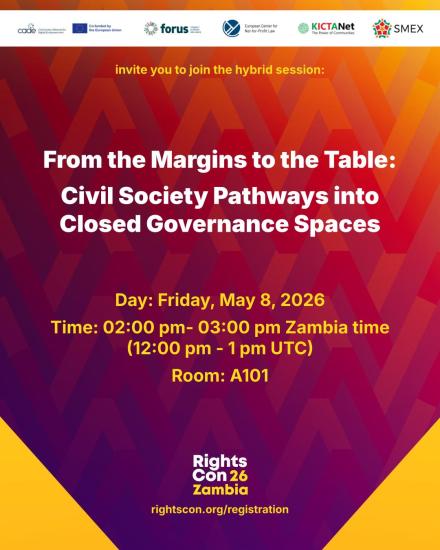
From the margins to the table: civil society pathways into closed governance spaces
14:00 - 15:00 | Hybrid roundtable
ECNL role: co-organiser with Forus as part of the CADE project.
Civil society has played a foundational role in shaping the internet. Yet, its influence on bodies designing critical technical standards that impact human rights (such as IETF, ICANN, ITU) remains fragmented and skewed toward the Global North. Research conducted by the CADE project confirms persistent barriers to participation, e.g. funding, language access, procedural complexity. This session will enable participants to learn from experiences in these and other processes that can be challenging to navigate, and co-develop strategies for embedding human rights and civil society perspectives in closed spaces.